What to Do When You Don’t Want to Show a Treat Each Time
Your dog can learn to follow a treat in a fraction of a second. Hold the treat by the nose and raise your hand. Your dog sits. Move it toward the floor and your dog goes down. It’s a good way to teach a new behavior, but if your dog only moves when the treat is already visible in your hand, the lure is lingering in your exercise longer than you want.
You want the behavior to occur independent of the visible treat. Now use the exact same hand movement, but with an empty hand. When your dog finishes the movement, mark the behavior and give the treat from your pocket or pouch. Your dog still gets reinforcement, but the reward is now coming after the behavior rather than before it. It begins to teach your hand signal as a signal in its own right.
At this point, you can add a verbal cue. Say the word, pause, then use your familiar hand signal. Say “down,” pause, then use the hand signal your dog already knows. Mark and reward. If you have repeated it clearly many times, eventually your dog will start moving on the verbal cue before the hand signal appears. At that point, don’t give the verbal cue and the hand signal at the same time. Let the dog have a chance to respond to the verbal cue first.
When your dog suddenly stops responding because the treat is out of view, don’t assume stubbornness. The lure may still be the primary signal in your cue. Back up. Find a quieter space with fewer distractions, or use one or two assisted cues if needed. Then try the empty hand cue again. It’s much more efficient to practice a series of behaviors, alternating between an easier version and a harder version, than to stand in one spot repeating a cue over and over.
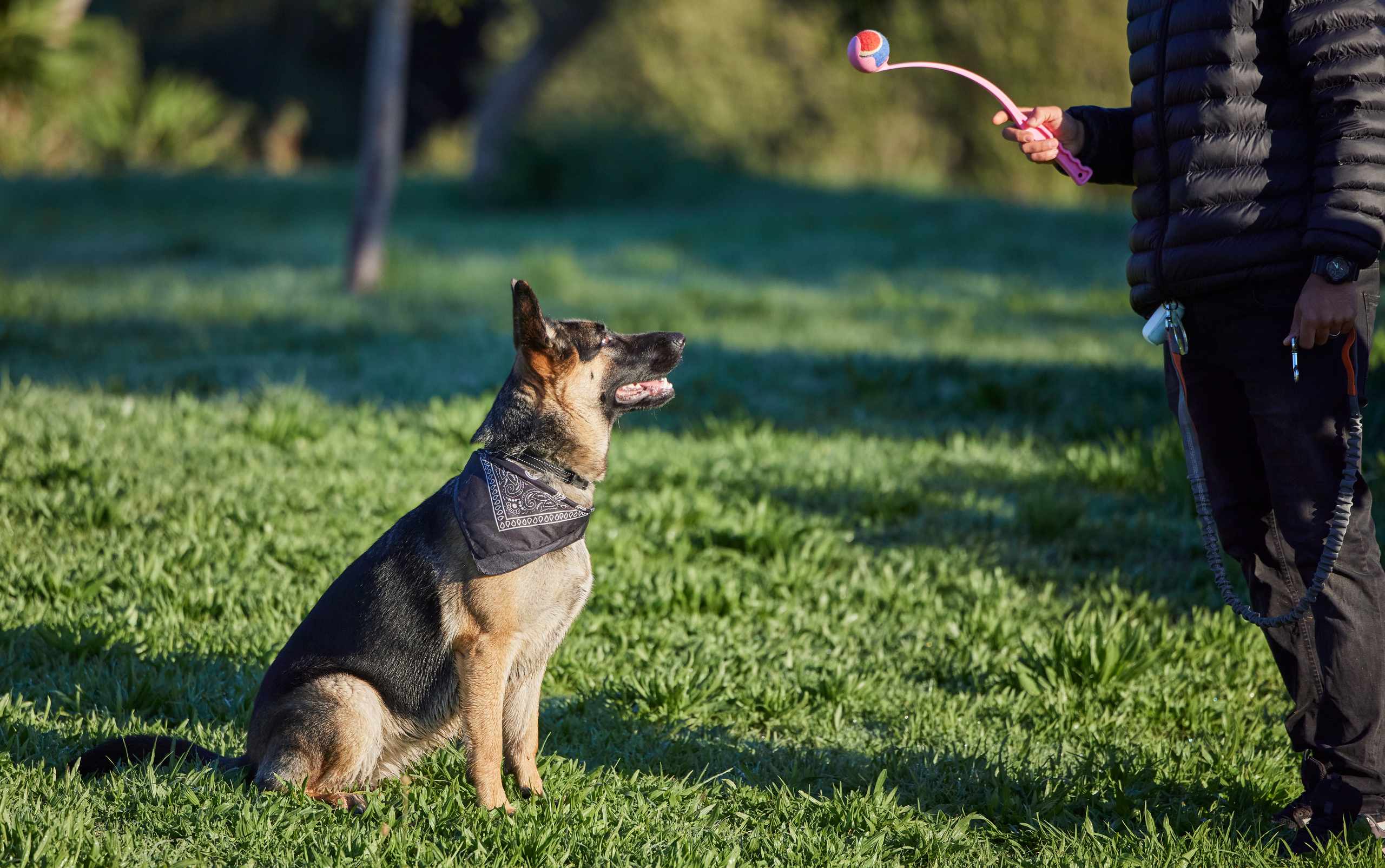
Try this out during a brief sit or down practice. Have a handful of treats readily available but hidden from your dog’s eyes. Give the verbal cue with an empty hand. If your dog responds, mark the behavior and give the treat afterward. Next, repeat using your known hand signal with no treat in your hand. If your dog doesn’t respond, don’t put the treat back in front of your dog’s nose. Go back to an easier exercise or a less distracting environment.
But don’t stop reinforcing your dog’s behavior just because you are fading out the lure. Reinforcement can be food, praise, a toy, the opportunity to go somewhere, whatever motivates your dog, or anything else. All that changes is the sequence. Cue, behavior, marker, reward. This same sequence is important for building the foundation for recall, waiting, working on a mat, and leash check-ins. Your dog shouldn’t need to see the treat to know that responding to the cue brings a reward.
A good indicator of success is to be able to keep your hands in a neutral position when giving a familiar cue. Your dog hears the verbal cue or sees a hand signal, completes the behavior, and is then rewarded. The cue is the cue. The treat is just the treat.